

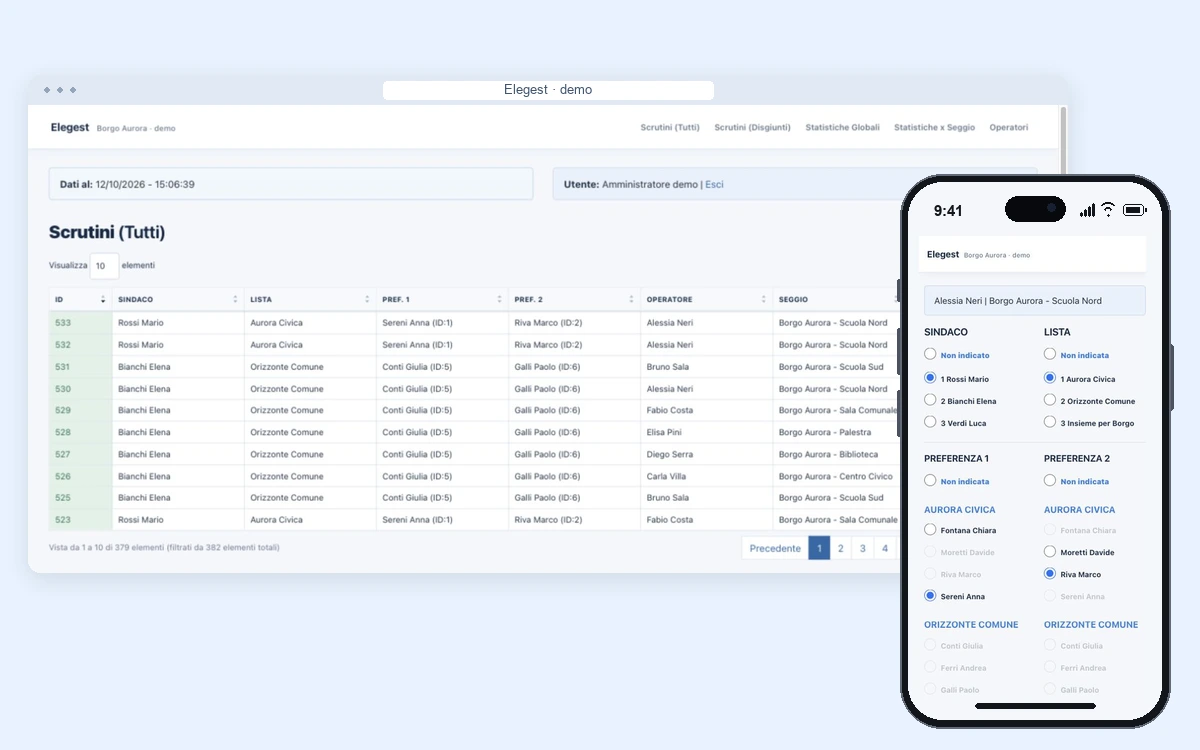
Elegest
Real-time vote counting, first developed around ten years ago. Operators record ballots on their phones; each entry is linked to an operator and polling section, with statistics updated during the count.
Collect data on a phone and review it as it arrives. Distribute QR tickets and validate them at the entrance. I develop web apps for specific needs: I start with your workflow and work with you to build the features you need.
When a process relies on manual steps, scattered data or unsuitable tools, I start with how the work happens before writing code: who enters information, who views it, which checks are needed and when.
If different people record information on their phones, they need one place to enter it. Whoever coordinates the work needs to know who each entry comes from and be able to view it while the work is in progress.
If people with different tasks use the same tool, each person needs to find the operations they require and access the relevant data.
If tickets or passes are distributed through a network of collaborators, three stages need to be connected: issuing them, delivering them to the recipient and checking them at the entrance.
A custom app is not always necessary. It makes sense when your workflow requires rules or connections that available tools do not handle well. If a spreadsheet or ready-made software meets the need, I assess it first and only propose custom development if it is not enough.
I define the operations before designing the screens: what to enter, what to check and what should happen next. Two projects show how this approach becomes usable features.
Real-time vote counting, first developed around ten years ago. Operators record ballots on their phones; each entry is linked to an operator and polling section, with statistics updated during the count.
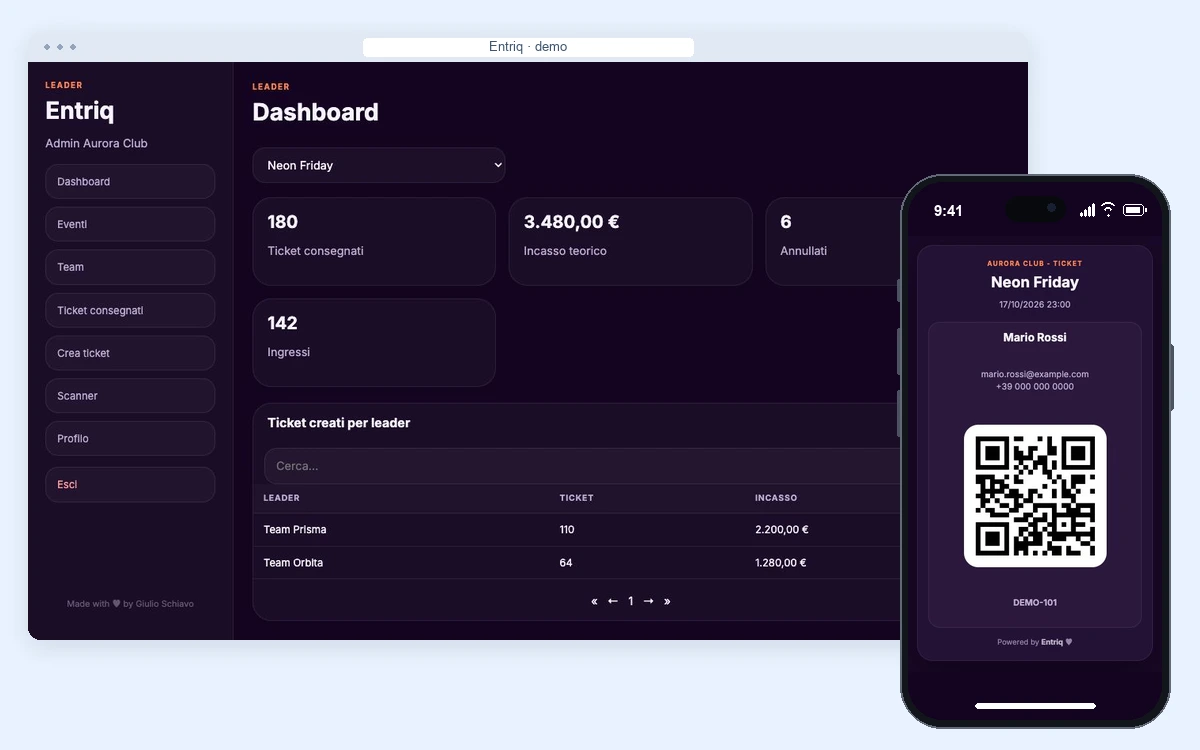
Ticketing with roles for promoters, leaders and entrance staff. Customers receive a QR ticket by email, which can be shared on WhatsApp with a pre-filled message. Each QR code can only be validated once.
Simplicity comes from decisions: showing the features each person needs, reducing steps and connecting data where it is needed. The structure also needs to allow for future adaptations.
In Entriq, promoters, leaders and entrance staff have different tasks. I design access and permissions around those responsibilities, so each person can find the operations they need.
In Elegest, votes are recorded on mobile. Forms, fields and checks reflect the context of use: information needs to be entered and checked away from a fixed workstation too.
Elegest links entries to operators and polling sections and refreshes views at regular intervals. Entriq connects tickets, email and WhatsApp sharing, separating venues, events and users to support adaptations.
We define objectives and analyse the current workflow: tasks, people, data and constraints. We assess whether a custom app is actually needed.
I propose features, priorities, timelines and costs before we begin. We define what the first version needs to do and what can be addressed later.
I develop the application and show you the work. We check screens, permissions and features against real use scenarios; I gather feedback and address issues found during testing.
We prepare the launch, training and instructions. We agree on access and support; future updates are assessed based on how the app is used.
By analysing your objectives and how you work. I compare the steps you need to manage with what existing tools offer: if a spreadsheet or ready-made platform is sufficient, a custom application is unnecessary.
The cost depends on defining objectives, auditing and analysing the workflow, development, testing and training. An app with relatively simple features and an analysis requiring only a few hours can cost less than €1,000. This is not a standard price: the quote and timeline are defined for the project before work begins.
In some cases, yes. Custom development can cost less, or pay for itself over time, compared with subscriptions or licences for existing software. The comparison needs to include the total cost: initial development, hosting, maintenance, updates and the alternative platform’s fees. The benefit depends on the need and how long the tool will be used.
It depends on the complexity of the features and the analysis required. AI tools can greatly speed up some development activities; understanding the process, testing and training remain essential. After the analysis, I propose priorities and a timeline for a first usable version.
A web app runs in a browser. I design screens for the intended devices and tasks, such as mobile vote entry in Elegest. Integrations are assessed case by case: in Entriq, for example, tickets are sent by email and can be shared on WhatsApp with a pre-filled message.
Alongside the features, we agree on training, access and instructions. Ownership and handover of data and code, hosting, support and any ongoing costs are terms to clarify in the project proposal, so you know what the work includes and what to plan for after launch.
Tell me what you have in mind. With a free 20-minute check, we’ll work out what you need and where to start.
You do not need to arrive with everything worked out: we can explore it together.